Introduction to memory
There are many memory technologies to choose from but only a few
are practical. The choice is influenced primarily by capacity
and access speed. Generally speaking:
- Faster is smaller
- Bigger is slower
That is enough for the moment; this is not the place to go into all
the details of why. Ask if you care or see below!
Exploration: What
Every Programmer Should Know About Memory (Drepper 2007) is
an excellent article although it is rather long (and, perhaps,
rather detailed) for most programmers!
Here are some short videos from Microchip Technology on memory
technologies. They are a bit closer to ‘engineering’ than
‘architecture’ but they make some relevant points quite
well. The more significant technologies are emboldened.
The bits you definitely should remember are:

- SRAM
- Static RAM has an area cost/bit which is a lot less than processor
registers but higher than DRAM. It is quite fast and provides genuine
random access. In our main memory hierarchy it is used in
all cache levels.
SRAM chips are manufactured with the same steps as processing chips
and can easily be integrated with processors and other logic.
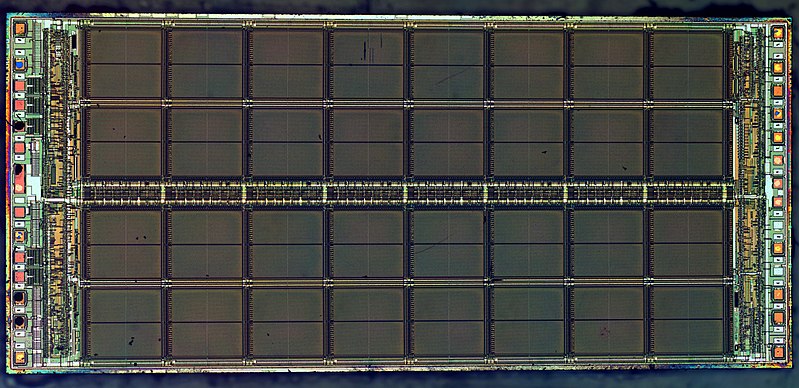
- DRAM/SDRAM
- Dynamic RAM has a low area cost/bit. It is slow compared to
processor cycles and the timing varies somewhat depending on access
patterns. It forms the bulk of the addressable memory in most
systems.
SDRAM is Synchronous DRAM: i.e. DRAM with a state
machine to make access faster and more convenient.
DRAM chips use some different manufacturing steps and are typically
separate from processing chips.

- Flash memory
- This is a permanent store. It is used in the address space of
some systems, particularly embedded controllers but is probably
more widely used for long-term storage – like file-systems.
[There are different ‘flavours’ of Flash memory for RAM
(“NOR”) and backing store (“NAND”)
applications.]
Flash memory (also extra manufacturing steps) is sometimes
integrated with processing chips – usually to make single chip
microcontrollers or similar..
Chip-chip links involve longer wires than on-chip connections and, hence are slower and more power-hungry. Shortening connections is currently of significant interest.
More exploration: Rather than the flat PCB (Printed Circuit
Board) connection some vertical connection may be used. You could
check out:
DRAM has enough properties which may be visible to the hardware
architect – and even the software programmer – that it
forms the subject of the next page.
Next: SRAM.